
Dyes and quenchers are two essential components in many diagnostic assays, particularly those that utilize fluorescence resonance energy transfer (FRET). FRET is a process where the energy absorbed by a fluorophore (dye) is transferred to a quencher molecule in close proximity. This transfer of energy disrupts the fluorophore’s ability to emit its own fluorescence, resulting in a signal that can be measured.
Dyes and quenchers are widely used in various diagnostic assays, including:
Real-time PCR (qPCR): qPCR is a technique used to detect and quantify specific DNA sequences. In qPCR assays, dyes and quenchers are often attached to oligonucleotide probes that bind to the target DNA sequence. When the probe is intact, the quencher absorbs the energy from the dye, preventing fluorescence. However, when the probe hybridizes to the target DNA, the dye and quencher are separated, allowing the dye to fluoresce. The increase in fluorescence signal indicates the presence and quantity of the target DNA.
Immunofluorescence assays (IFAs): IFAs are used to detect antigens (molecules that the body’s immune system recognizes) in tissues or cells. In IFAs, dyes can be conjugated to antibodies that bind to specific antigens. The presence of a fluorescent signal indicates the presence of the target antigen.
The use of dyes and quenchers allows for the development of highly sensitive and specific diagnostic assays. These assays play a critical role in the diagnosis and management of various diseases.
Filter
11 product(s) in total
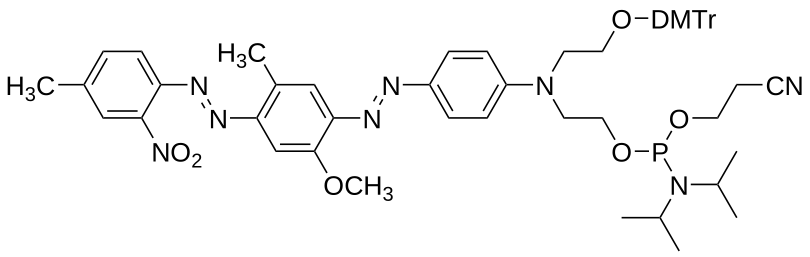
HDQ1 Phosphoramidite
C55H63N8O8P
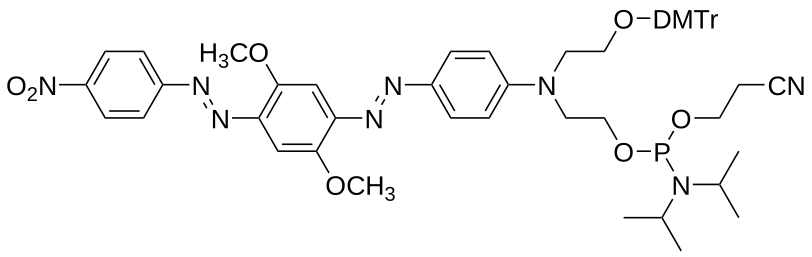
HDQ2 Phosphoramidite
C54H61N8O9P
HEX Dye Amidite
C46H52N3O10Cl6P
5′-Biotin Phosphoramidite
C46H64N5O6PS
Fluorescein-dT Phosphoramidite
C79H89N6O17P

Cyanine 3 Phosphoramidite
C58H70ClN4O4P
HQ-F554 Phosphoramidite
C52H59Cl3N3O10P

Cyanine 5 Phosphoramidite
C60H72ClN4O4P
6-ROX NHS Ester
C37H33N3O7
HDQ-1 CPG 1000Å
HDQ-2 CPG 1000Å


- 10 / Page
- 20 / Page
- 50 / Page