Linkers play a vital role in oligo synthesis, specifically in two main applications:
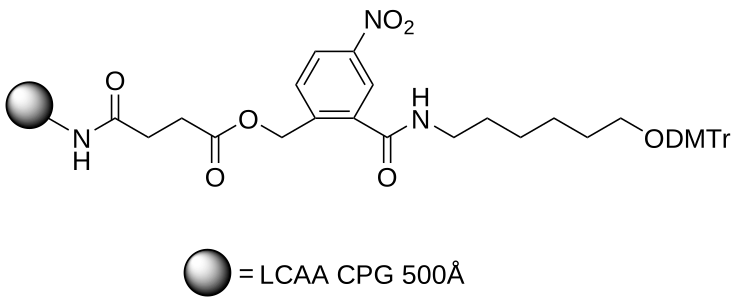
Solid Phase Attachment: During oligonucleotide synthesis, a linker molecule covalently attaches the growing oligonucleotide chain to a solid support. This solid support is typically a controlled-pore glass (CPG) bead. The linker offers a stable bond to the solid phase, allowing for the stepwise addition of nucleotides to create the desired oligonucleotide sequence. After synthesis is complete, the linker is cleaved under specific conditions, releasing the purified oligonucleotide from the solid support.
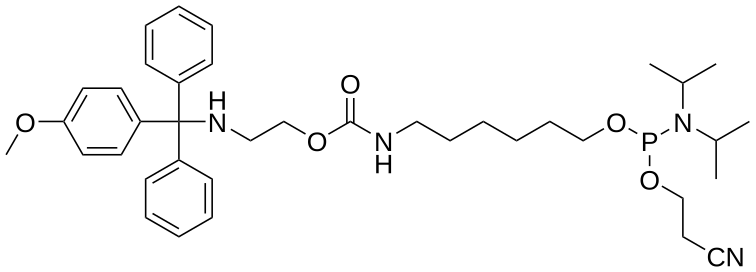
Bioconjugation: Linkers can also be incorporated at either the 5′ or 3′ terminus of the oligonucleotide to facilitate conjugation with various biomolecules. These biomolecules can include fluorophores, quenchers, antibodies, nanoparticles, or other functional groups. Bioconjugation allows researchers to attach functionalities to the oligonucleotide, enabling diverse applications such as:
• Fluorescence in situ hybridization (FISH) for cellular imaging
• Detection of specific nucleic acid sequences
• Immunoassays
• Drug delivery
There are various types of linkers available for oligo synthesis, each with unique properties and functionalities. Some common linker types include:
• Cleavable Linkers: These linkers are designed to be cleaved from the solid support under specific conditions, such as exposure to acid or base. This allows for the release of the purified oligonucleotide.
• Non-Cleavable Linkers: These linkers form a permanent bond with the solid support. While the oligonucleotide remains tethered to the solid phase, non-cleavable linkers are useful for applications like microarrays where the oligos stay attached to the surface.
• Biotinylated Linkers: These linkers contain biotin, a small molecule that can bind to streptavidin with high affinity. This property allows for easy purification of the oligonucleotide using streptavidin-coated magnetic beads.
• Fluorescent Linkers: These linkers incorporate a fluorescent moiety, enabling the direct detection of the labeled oligonucleotide.
The choice of linker in oligo synthesis depends on the desired application and the downstream processes involved.
Filter
70 product(s) in total
Peracetylated GalNAc PEG linker-Azide
Peracetylated GalNAc PEG linker-Amino
3′-thiol modifier 6 S-S-DMTr-linker CPG (1000Å)
3′-thiol modifier 6 S-S-DMTr-linker-succinate, TEA salt
C35H44O9S2(free acid)
Cholesteryl succinate, TEA salt (plant source)
C61H86O9 (free acid)
Cholesteryl-TEG-succinate (plant source)
C65H93NO13 (free acid)
DMTr-hydroxymethyl hexyl-Biotin Phosphoramidite
C47H66N5O7PS
2-cyanoethyl (6-(3-(prop-2-yn-1-yloxy)-2,2-bis((prop-2-yn-1-yloxy)methyl)propoxy)hexyl)
12-O-DMTr-dodecane-bis-(diisopropylamino)-Phosphane
C45H71N2O4P
1, 3-di-O-DMTr-glycerol-CE-Phosphoramidite
C54H61N2O8P
NHMMTr-C8 Phosphoramidite
1, 3-di-O-DMTr-glycerol-bis-(diisopropylamino)-Phosphane
C57H71N2O7P
6-O-DMTr-hexane-bis-(diisopropylamino)-Phosphane
C39H59N2O4P
NHMMTr-C5 Phosphoramidite
NHMMTr-C7 Phosphoramidite
Spacer C12 Phosphoramidite
C42H61N2O5P
MMTr C3 linker Phosphoramidite
NHMMTr-C4 Phosphoramidite
Cholesterol tetraethylene glycol (TetraEG) amidite (plant source)
C48H86N3O8P
n-Butyl-2-cyanoethyl-N, N-diisopropylphosphoramidite
DMTr-Cholesteryl-TEG Phosphoramidite (plant source)
C70H106N3O11P
Benzyl N-[2-(Fmoc)aminoethyl]glycinate
t-butylbenzoyl biotin-NHS ester
1, 3-dioxo-2-(6-dimethoxytrityloxyhex-1-yl)isoindole-5-carboxylic acid, TEA salt
C36H35NO7
2, 5-dioxopyrrolidin-1-yl-3-(dodecyldisulfaneyl)propanoate
1, 3-dioxo-2-(3-dimethoxytrityloxyprop-1-yl)isoindole-5-carboxylic acid, TEA salt
C33H29NO7 (free acid)
N-[2-[(2-Aminoethyl)amino]ethyl]-1,2-dithiolane-3-pentanamide
N2-[5-(1,2-Dithiolan-3-yl)-1-oxopentyl]-L-arginine methyl ester
3′-thiol modifier 6 S-S-DMTr-linker CPG (500Å)
Biotin-LC-NHS Ester
(R)-4-((1-((((9H-fluoren-9-yl)methoxy)carbonyl)amino)-3-(bis(4-methoxyphenyl)(phenyl)methoxy)propan-2-yl)oxy)-4-oxobutanoic acid, Pyridine salt
C43H41NO9
Glucose C4 alcohol
benzyl 6-aminohexanoate
C20H27NO5S
Methacrylate C6
(S)-2-amino-3-(bis(4-methoxyphenyl)(phenyl)methoxy)-1-(4-(hydroxymethyl)piperidin-1-yl)propan-1-one
C30H36N2O5
2-(2-nitrophenyl)propyl imidazole-1-carboxylate
β-Mannose C4 alcohol
α-Mannose C4 alcohol
Galactose C4 alcohol
Cholesterol-TEG
C61H89NO10
Cholesteryl amidite (plant source)
C68H103N2O10P
1-(4,4′-Dimethoxytrityloxy)-3-(6-(Cholest-5-en-3β-oxy)hexyloxy) propan-2-ol (plant source)
C57H82O6
Cholesterol tetraethylene glycol (TetraEG) (plant source)
C39H69NO7
Ethyl-γ-(N-(3-hydroxypropyl)anilino)-butyrate
Propargyl-PEG2-NH2
6-amino(Fmoc)-1-O-DMT-2-hydroxymethylhexan-1-ol
N-Fmoc-2-(2-aminoethoxy)ethanol
5′-DMT-dT-linker-NH2
C39H46N4O8
DFA-AH Linker Amidite
Phenylacetyl HA amidite linker
Fmoc-AEG-OMe•HCl
Fmoc-AEG-OH•HCl
N-(Boc-aminoethyl)-Gly-oEt
4-[3-[bis(4-methoxyphenyl)-phenylmethoxy]propoxy]-4-oxobutanoic acid, triethylamine salt
Diethyl 2-(4-chlorobutyl)malonate
(R)-2-amino-3-(bis(4-methoxyphenyl)(phenyl)methoxy) propan-1-ol
C24H27NO4
1-O-DMTr-Glycerol-TEG-Cholesterol-2-CE-Phosphoramidite
C68H103N2O10P
Fmoc-aminopropyloxy-3-DMTr-glycerol
TFA-EO Linker
1, 3-Di-DMT Glycerol succinate, TEA salt
C49H48O10
TEG linker
C9H21NO4
TEG Linker2
C33H45NO8
6-N3-1-hexanol
6-amino(Fmoc)-2-hydroxymethylhexan-1-ol
DMT-Hexylamine-linker Phosphoramidite
C36H50N3O4P